Why We Built Social Work Hours, a Michigan School Social Worker CE Tracker
Two credentials, two renewal clocks, and a lot of hours to keep straight. The problem we set out to fix, what we heard at MASSW, and how the app works.
My wife, Shannon, has been a school social worker in Michigan since 2011. For most of that time she tracked her continuing education in a notebook. Every workshop, conference session, and webinar went in by hand, with a note about which credential it counted toward. When a renewal came up, she went back through the pages and added it all up.
That's how a lot of Michigan school social worker CE gets tracked: notebooks, spreadsheets, a folder of certificates in a desk drawer. It works for a while. What makes it hard is that most school social workers aren't tracking one set of requirements. They're tracking two, and the two don't line up.
Two credentials, two clocks
To work in a Michigan school, most social workers hold a social work license from LARA (an LMSW or LBSW) and a School Social Worker Certificate from the Michigan Department of Education. Each one renews on its own schedule with its own rules.
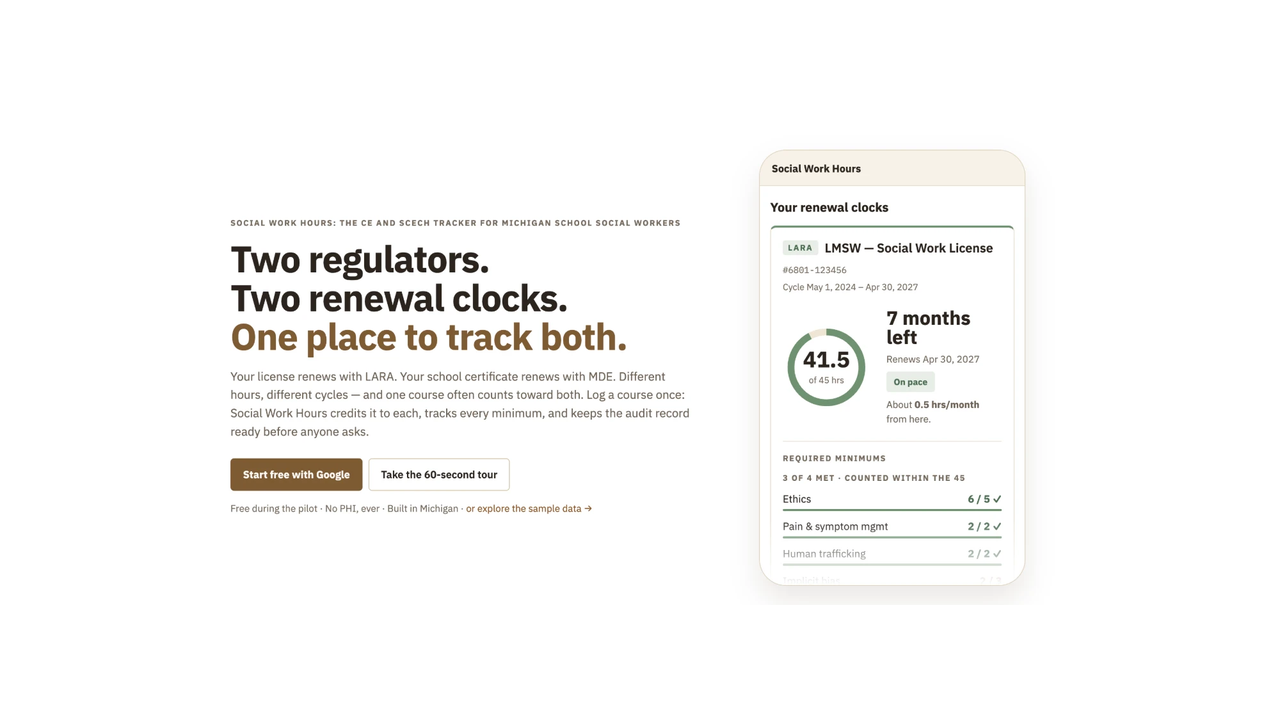
The LARA license needs 45 hours every three years, and it expires April 30. Within those 45 hours there are minimums for ethics, pain and symptom management, implicit bias, and human trafficking. There's also a limit on how much can come from non-interactive online self-study. LARA doesn't track any of this as you go. Renewal is on the honor system, and you keep your proof for years in case you're audited.
The MDE certificate needs 75 hours of professional learning every five years, and it expires June 30. Those hours come from SCECHs, college credit, or DPPD, and MOECS is the system of record. SCECHs can take some time to show up in MOECS after a session ends.
So the cycles are different lengths, end in different months, and count hours in different ways. Michigan also doesn't let extra license hours carry over, so going past the minimum in one cycle doesn't help with the next one.
A single training can count toward both credentials, though not always in the same way. A six-hour workshop might count as four hours of ethics and two general hours toward the license, and as six SCECHs toward the certificate. Over five years and a few dozen trainings, that adds up to a lot of bookkeeping on top of a caseload.
That's the two-clock problem. Shannon was handling it with a pen, and we thought an app could do the adding up for her.
What we heard at MASSW
We brought Social Work Hours to the MASSW Annual State Conference, October 28 to 30, and talked with school social workers about how they keep track of their hours. We loaded the conference's published sessions into the app ahead of time, so attendees could mark the sessions they went to as the conference happened.
A few things came up again and again.
Almost everyone has a system, and almost every system is personal. A notebook, a spreadsheet, an email folder full of certificates. What most people didn't have was one place where it all added up.
The harder part was knowing where each hour counted: which LARA requirement a session covered, whether it carried SCECHs, and how close they were to the online self-study limit.
MOECS timing was a common worry. People weren't always sure whether SCECHs from a session had posted yet, or whether they should be following up on them.
Renewal also tends to sneak up. Some people described realizing in the spring that one of the required areas was short and then hunting for a course to fill it before the deadline.
It matched what Shannon had been telling us, and it was useful to hear it from a much wider group.
How Social Work Hours handles Michigan school social worker CE
Social Work Hours is a web app built for Michigan school social workers. It supports LMSW and LBSW license holders along with the Professional and Preliminary School Social Worker Certificates. Here's what it does.
- One card per credential. Each one shows the months left until renewal, the hours you've earned, and your progress on every required area.
- Log once, count twice. You enter a course one time. The app counts it toward both credentials and lets you split the hours across LARA requirements, so the six-hour workshop above lands in all the right places.
- Early warnings. The app tells you if you're behind pace, getting close to the online self-study limit, short in a required area, or waiting on SCECHs that are still pending in MOECS.
- Reminders with your numbers in them. You get reminders at 12, 6, 3, and 1 month before renewal, and they get more direct if you're behind.
- An audit vault. When a cycle closes, its totals are frozen and kept with a PDF transcript and your certificates. You can export your data or delete your account at any time.
- Built for your phone. Log a session as you leave the room, take a photo of the certificate, and add the app to your home screen.
- Backfill. Already partway through a cycle? You can add earlier courses by their completion date, including ones from closed cycles.
There are a few things it doesn't do, and we want to be clear about them. Social Work Hours isn't affiliated with LARA, MDE, or MOECS, and it doesn't submit anything to the state for you. We verified the requirement values in September 2026, but rules change, so it's still worth confirming the current requirements with the state and in MOECS. We also don't store any health information. The app keeps your account, your credentials, and your course records, and nothing about your students or clients.
It's free during the pilot. If that changes, current users will hear about it well in advance. We're also planning a district and ISD version with staff rosters and compliance dashboards, so administrators can see where their team stands without chasing spreadsheets.
How Springthrough builds software for problems like this
Social Work Hours is a Springthrough product. Springthrough is a Grand Rapids technology partner with 25+ years in business, and custom software is a big part of what we do.
This app followed the same path we use for client work.
We started with one person's real problem. Before writing any code, we wrote down the rules: both renewal cycles, every required area, the self-study limit, how MOECS fits in, and what happens when a cycle closes.
Then we built a prototype and put it in front of Shannon. She used it, told us what was wrong, and we fixed it. Things like keeping transcripts from past renewals and handling the end of a cycle came out of that back and forth.
Once other social workers asked to use it, we set it up so anyone could have their own account. Then we took it to MASSW to hear from school social workers across the state.
We're still changing it based on what we heard. We care most about getting something real into people's hands early and letting the people doing the work tell us what to build next. It's how we'd want to approach a problem in your organization, too.
If you're a Michigan school social worker, you can sign up for Social Work Hours for free at socialworkhours.com. If you work for a district or ISD and the staff view sounds useful, we'd like to hear what you'd need from it. And if your organization has its own version of the two-clock problem, Springthrough would be glad to help you think it through.
If any of this lines up with where you are right now, we're glad to talk.
Have a two-clock problem of your own?
We build custom software for narrow, well-defined problems the off-the-shelf tools miss. If that sounds like something you're sitting on, let's talk.
Start a conversation arrow_forwardEric Spencer leads product at Springthrough, a Grand Rapids technology partner building custom software for mid-market and specialty teams.
Explore related

The Real Cost of Staying on an Old Sitefinity Version
Sitefinity Upgrade Planning: When to Lift and Shift vs. Rebuild